By Dr. Daniela Vergara
CBG: What Is It and What Does It Do?
In this post, I’m going to continue talking about my favorite cannabinoid, CBGA. We discussed previously about CBGA being the mother cannabinoid. Today, we’ll look at what it is, what it does, and how it might be used for medicine.
What is CBG?
CBG stands for cannabigerol. It’s a type of cannabinoid found in the cannabis plant (Cannabis sativa L.).
It’s not psychoactive, which means it won’t make you feel high. CBG is usually found in smaller amounts than THC or CBD [1], but it may have very helpful health benefits.
Where is CBG found?
CBG is made in the sticky resin glands (called trichomes) on the surface of the cannabis plant—mostly on the flowers of the female plant. All the other cannabinoids are made in these glands, which are basically a factory of cannabinoids (and other compounds)
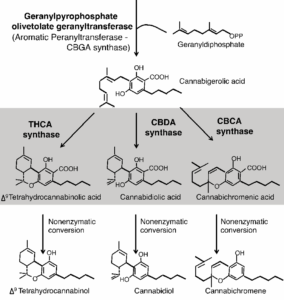
CBG comes from a compound called CBGA, which is the starting point for all the other cannabinoids in the plant. That’s why people call CBGA the “mother cannabinoid”, and you can read more about it in this previous post. From CBGA, which is the precursor molecule, the plant also makes THCA, CBDA, and CBCA.
When was CBG discovered?
CBG was first described in 1964 by researchers Gaoni and Mechoulam [2]. But for many years, most research has been focused on THC and CBD. Now, more attention is being given to this lesser-known but really interesting cannabinoid.
Some CBG facts
The cannabis plant (Cannabis sativa) makes all of its cannabinoids in an “acidic” form. You can tell because their names end with the letter “A,” like CBGA, THCA, and CBDA.
CBG (cannabigerol) is the “neutral” form that comes from CBGA (cannabigerolic acid) after it’s heated. This happens through a chemical reaction called decarboxylation, where the compound loses a small piece called a carboxyl group.
What’s the Difference Between CBD and CBG?
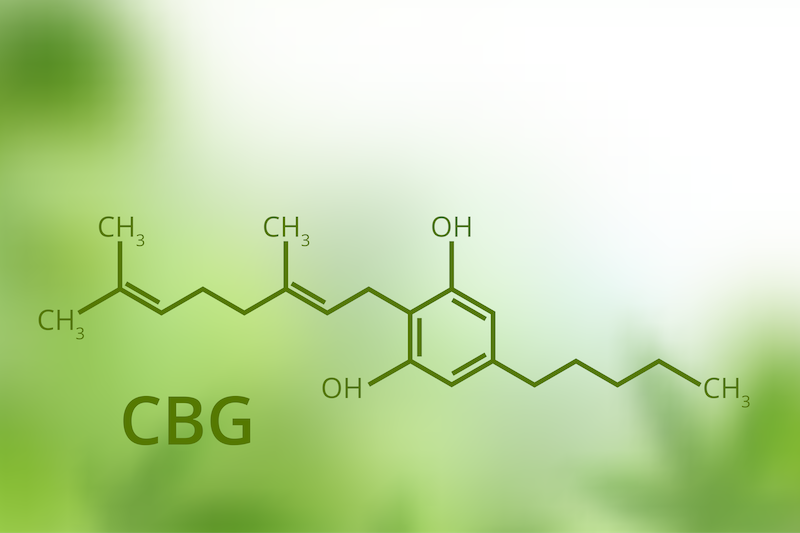
CBD (cannabidiol) and CBG (cannabigerol) are two of many cannabinoids found in the cannabis plant. They are similar in some ways, but they also have big differences in how they’re built and how they affect the body (figure 1).
Both CBD and CBG work with your body’s endocannabinoid system.
One key difference is that CBD has a more complex ring structure than CBG, and this small change makes them act differently in the body [3].
CBD has been studied a lot more and is approved for some medical uses. CBG still needs more research before we fully understand what it can do.

Figure 1. Chemical structure of CBGA (Cannabigerolic acid), CBG (Cannabigerol), CBDA (Cannabidiolic acid), and CBD (Cannabidiol).
Why Is CBGA Called the Mother Cannabinoid?
CBGA is known as the “mother” of all cannabinoids. That’s one of the reasons I like it, because it reminds me of the wonderful job of being a mom.
When the cannabis plant makes cannabinoids, it starts with CBGA. Then, enzymes called THCA synthase, CBDA synthase, and CBCA synthase turn CBGA into THCA, CBDA, and CBCA.
That makes CBGA the starting point or “precursor” of these three cannabinoids.. In lab settings, CBGA can lead to up to eight different cannabinoids. In our previous post we mentioned why are these synthases the party enzymes (promiscuous and sloppy), so check it out!
Does CBG Have Medical Benefits?
As we mentioned in that previous post, CBG and CBGA may have therapeutical benefits: by having neuroprotective effects on the brain [4], having anticancer properties and helping fight the illness [5], and useful treating epilepsy [6]
However, CBG (cannabigerol) hasn’t been studied as much as THC or CBD, which have been more popular for a longer. A few clinical trials are currently being done or have been finished recently to see if CBG might help with certain health problems:
- A study to see how CBG affects the mental, physical, and emotional wellness of healthy people (https://clinicaltrials.gov/study/NCT05743985)
- A study testing how CBG impacts anxiety, stress, and thinking (https://clinicaltrials.gov/study/NCT05257044)
- A study looking at whether CBG can improve sleep quality in veterans (https://clinicaltrials.gov/study/NCT05088018)
- A study testing cannabis oil with both CBD and CBG in people with ADHD (https://www.clinicaltrials.gov/study/NCT05219370)
Does CBG Have Cosmetic Uses?
Yes! In Europe, CBG is approved as a cosmetic ingredient. It’s on the official CosIng list (a list of allowed cosmetic ingredients), along with other cannabinoids like CBD and CBN.
How Do People Use CBG?
Right now, there is no official dose of CBG for taking it by mouth because we still don’t have enough research or clear rules. We also don’t know how it might interact with other medications. Since there’s not much information yet about how well CBG works or how safe it is, it might not be the best or first option for treatment at this time.
CBG Oil
CBG oil is in a “gray area” when it comes to the law. Because CBG doesn’t cause a high like THC, it’s not considered a drug. However, there aren’t clear rules yet about using it internally (like swallowing it).
That’s why most CBG oils are only sold for external use, like in skin care products.
If you use full-spectrum cannabis oil, it probably has small amounts of other cannabinoids in it too—including CBG.
CBG Power
CBG is a cannabinoid with exciting medical possibilities, but we still have a lot to learn about it.
As an evolutionary biologist, what I love most about CBG is how it works at the biochemical level, and its gene structure. This “mother cannabinoid” helps make many different proteins and is key to producing other cannabinoids during the plant’s natural process. You can read more about this in our previous post.
I hope I’ve shown you why CBG is my favorite: it’s cool, important, and full of potential. Until next time!
1. Smith, C.J., et al., The phytochemical diversity of commercial cannabis in the United States. PLoS one, 2022. 17(5): p. e0267498.
2. Gaoni, Y. and R. Mechoulam, The isolation and structure of cannabinolic cannabidiolic and cannabigerolic acids. J Am Chem Soc, 1964. 86: p. 1646-1647.
3. Navarro, G., et al., Cannabigerol action at cannabinoid CB1 and CB2 receptors and at CB1–CB2 heteroreceptor complexes. Frontiers in pharmacology, 2018. 9: p. 632.
4. Valdeolivas, S., et al., Neuroprotective properties of cannabigerol in Huntington’s disease: studies in R6/2 mice and 3-nitropropionate-lesioned mice. Neurotherapeutics, 2015. 12(1): p. 185-199.
5. Borrelli, F., et al., Colon carcinogenesis is inhibited by the TRPM8 antagonist cannabigerol, a Cannabis-derived non-psychotropic cannabinoid. Carcinogenesis, 2014: p. bgu205.
6. Anderson, L.L., et al., Cannabigerolic acid, a major biosynthetic precursor molecule in cannabis, exhibits divergent effects on seizures in mouse models of epilepsy. British journal of pharmacology, 2021. 178(24): p. 4826-4841.